PERFORMANCE AND READING GROUP
Join Chloe Chignell for a performance of SUNCUT and Summer Reading Group [Try to remember, or failing that, invent.]
PERFORMANCE DATE
25 JANUARY 2026
SUNDAY
5PM–7:30PM
TICKETS: $15
BOOK HERE
READING GROUP DATES
13, 20, 27 JANUARY 2026
TUESDAYS
6:30PM–8PM
FREE REGISTRATION
LOCATION
THE DRILL HALL, CRITICAL PATH
1C NEW BEACH ROAD, DARLING POINT, NSW, 2027
GADIGAL & BIRRABIRRAGAL COUNTRY
…
PERFORMANCE
SUNCUT: a lover’s dictionary
But remember. Make an effort to remember. Or, failing that, invent.
SUNCUT: a lover’s dictionary is a lexicon of 366 gestures that attempts to embody the 366 entries in Lesbian Peoples: Materials for a Dictionary written by Monique Wittig and Sandie Zeig (1979). In an act of speculative reanimation SUN CUT is an anticipatory document remembering a future yet to arrive. The work unfurls word by word, body by body. Each iteration of the performance progresses through the dictionary: gathering bodies, gestures, dances. It resists linguistic fixity in order to embrace language as a site of transformation, refusal, and reinvention. Inverting the status of printed material in archival practices SUN CUT asks how the body can be both a site and means of preservation.
Lesbian Peoples: Material for a Dictionary is a speculative dictionary that dismantles patriarchal language to posit a world of lesbian relation. Through fragmented definitions and poetic inventions, it reframes language as a site of resistance. Its entries range from definitions of everyday terms to elaborate accounts of mythical events, political movements and cultural practices. The book itself is a queer critique of linguistic authority and its role in enforcing dominant ideologies. Wittig and Zeig subvert the dictionary’s normal function, as a tool of mastery and control, and reshape it into a generative field where language destabilises its own conditions of use. Building on these foundations, SUNCUT approaches Lesbian Peoples not simply as a book but as a practice—a framework for reorganising the body through language.
Duration: 2.5 hrs
Please note the audience are welcome to enter and exit throughout the duration.
CREDITS:
Concept, Choreography and Performance: Chloe Chignell
Sound and Performance (Sydney edition): Mara Schwerdtfeger
Sound Collaborations: Steph Holl-Trieu, Amina Szecsödy.
This work is supported by Critical Path Sydney, Artspace Sydney, Dancehouse Melbourne, GC De Maalbeek, n22 Brussels, Kunstendecreet, Cité des arts, Paris.
This work has been presented at Pride Museum, MIMA, Brussels, Summer University, Performing Arts Forum, St Erme, France and PACT Zollverein, Essen.
[READING GROUP] Try to remember, or failing that, invent
Join us for a summer reading group gathering on Tuesday evenings throughout January, where we will collectively read Lesbian Peoples: Materials for a Dictionary (1976) by Monique Wittig and Sande Zeig, a novel whose unruly poetics and radical politics reimagines the history of language.
Across three sessions, we’ll explore how the text retools the dictionary form to unmake patriarchal grammar, to conjure futures and ancestries, and to insist on lesbian as a world-making force rather than an identity category. We’ll read aloud, follow the text’s strange leaps, consider its visions and contradictions, and ask what it means to invent language when the available ones fail.
The sessions will be facilitated by Chloe Chignell, a choreographer and writer. S/he will guide sessions and the conversation between close reading and open speculation.
No prior study or preparation is necessary.
The reading will be held in English, and French editions will be available for those who wish to move between versions or listen for echoes of the original text.
About Lesbian Peoples: Material for a Dictionary
by chloe chignell
Lesbian Peoples: Material for a Dictionary stages a scene of dissociation from the ordinary, an act of lexical disorientation. Written by Monique Wittig and Sande Zeig, this dictionary, a hybrid of speculative fiction, poetic prose and mythic historiography, does not so much catalog meaning as it disorients meaning’s hold. It performs a dismantling of the hegemonic semantic field, the everyday contract of intelligibility under heteropatriarchy and what Wittig terms ‘the straight mind’, and in its place offers an unstable architecture of a world rooted in lesbian subjectivity. It uses the dictionary as a weapon against itself to cast forth another order: the dream of a lesbian social.
Wittig and Zeig’s project operates in a register of estrangement–radical, utopian, but never naive. What they give us is no representation but the infrastructure of a different affective economy, one whose signs are invented, recursive, lacunary and polysemous. The dictionary form promises order, and yet delivers sedimented fragments, surreal etymologies and speculative ruins. The book performs the inevitable failure to systematically capture and catalogue language and in so doing renders the dictionary literature amongst literature.
This is not simply an exercise in lesbian-feminist world-building, though it is that too. It is a world that metabolises the violence of language and offers up a counter-discourse saturated with the pleasure and difficulty of disorientation and disidentification. There is no straight line of meaning here. Instead, the reader is asked to inhabit the broken rhythm of an alternate semiotics–one shaped by a lesbian imaginary that does not attempt to be a mirror to reality but a site of sensual resistance to it.
Lesbian Peoples is an archive of a negated sociality, a fantasy that thickens in the absence of legibility. It is affective not because it overflows with sensuality, but because it registers the impasse of being intelligible within a language that was never intended for you to speak. It is awkward, lush, deliberately excessive and self aware. It insists on the sensual labor of reading differently, of touching language differently, of being moved by the erotics of word-dismantling.
In this way, Lesbian Peoples is not a relic of radical feminism’s past, but a living document of how literature can be a form of political work. It is less concerned with what lesbians are than with what lesbianism does: as an interruption, as an atmosphere, as an unruly archive of possibility.
ABOUT CHLOE CHIGNELL
Chloe Chignell (AU, 1993) is an artist working across text, choreography and publishing. Her work focuses on language within a choreographic frame. She invests in writing as a body building practice and in practices of experimental translation. Chloe graduated from a.pass (BE, 2020), from the research cycle at P.A.R.T.S (BE, 2018) and from VCA (AU, 2013). Since 2019, Chloe co-runs rile* a bookshop and project space for publication and performance with Sven Dehens. Her work has been presented across Europe and Australia including: NEXT Festival (2024), Pavillon ADC (2024), Batard Festival (BE, 2019) Saal Biennale (ES 2021), Moving Words Festival (NO 2021), QL2 (AU 2022), KAAP (BE 2022), Littérature etc. (FR 2022), Dancehouse (AU 2016-8), The Kier Choreographic Award (AU 2018) Kottinspektionen (SE 2019) and Venice Biennale of Dance (IT 2017) among others. She has performed for and collaborated with choreographers across Europe and Australia including: James Bachelor, Angela Goh, Bryana Fritz, Stefa Govaart, Ingrid Berger Myhre, Adriano Wilfert Jensen, Phoebe Berglund, Anna Gaiotti, Clara Amaral and Gry Tingskog. In 2020 she published The Complete Text Would Be Insufferable with uhbooks, edited by Will Holder and has a forthcoming book with Berlin based lesbianas concentradas. Her writing has been published in: misted.cc (NL), Choreography Journal (NO), Le Chauffage (BE), RealTime (AU), This Container Magazine (SE/BE), …and then the doors open again (BE/NL) and Engagement Arts Zine (BE). She also teaches choreographic and writing workshops at P.A.R.T.S. (BE), HZT (DE), ISAAC (BE) and the VCA (AU).
https://www.chloechignell.com/choreography/suncut-a-lovers-dictionary
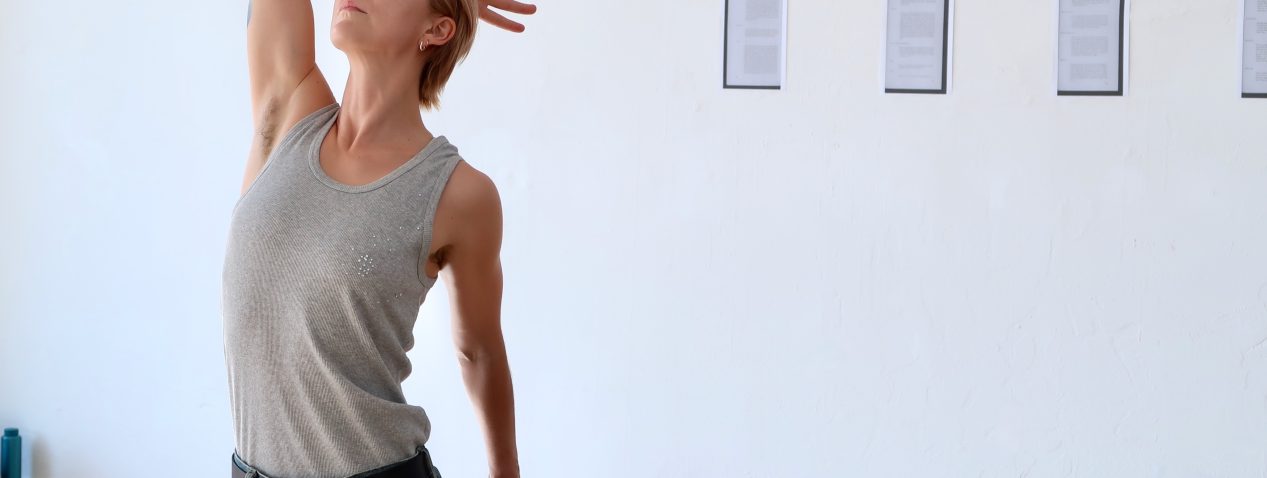
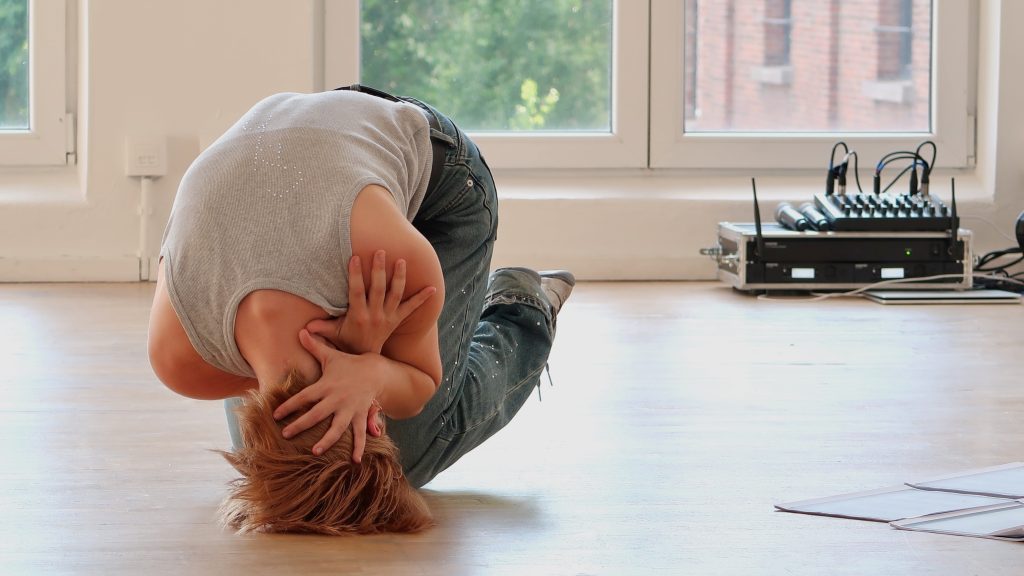
IMAGE CREDITS: Chloe Chignell, SUNCUT: a lover’s dictionary, photo by Stine Sampers, June 2025.
IMAGE #1 ID: an image of a person performing. They are standing and looking up with one arm bent at a right angle and hand behind their head, and the other arm stretched down behind them. Their fingers are reaching out, almost like stars.
IMAGE #2 ID: an image of a person performing. An image of a person performing. They are curled up in a ball, with the crown of their head resting into the floor. Their hands are visible with one pressing into the back of their head and the other pressing into their shoulder.